
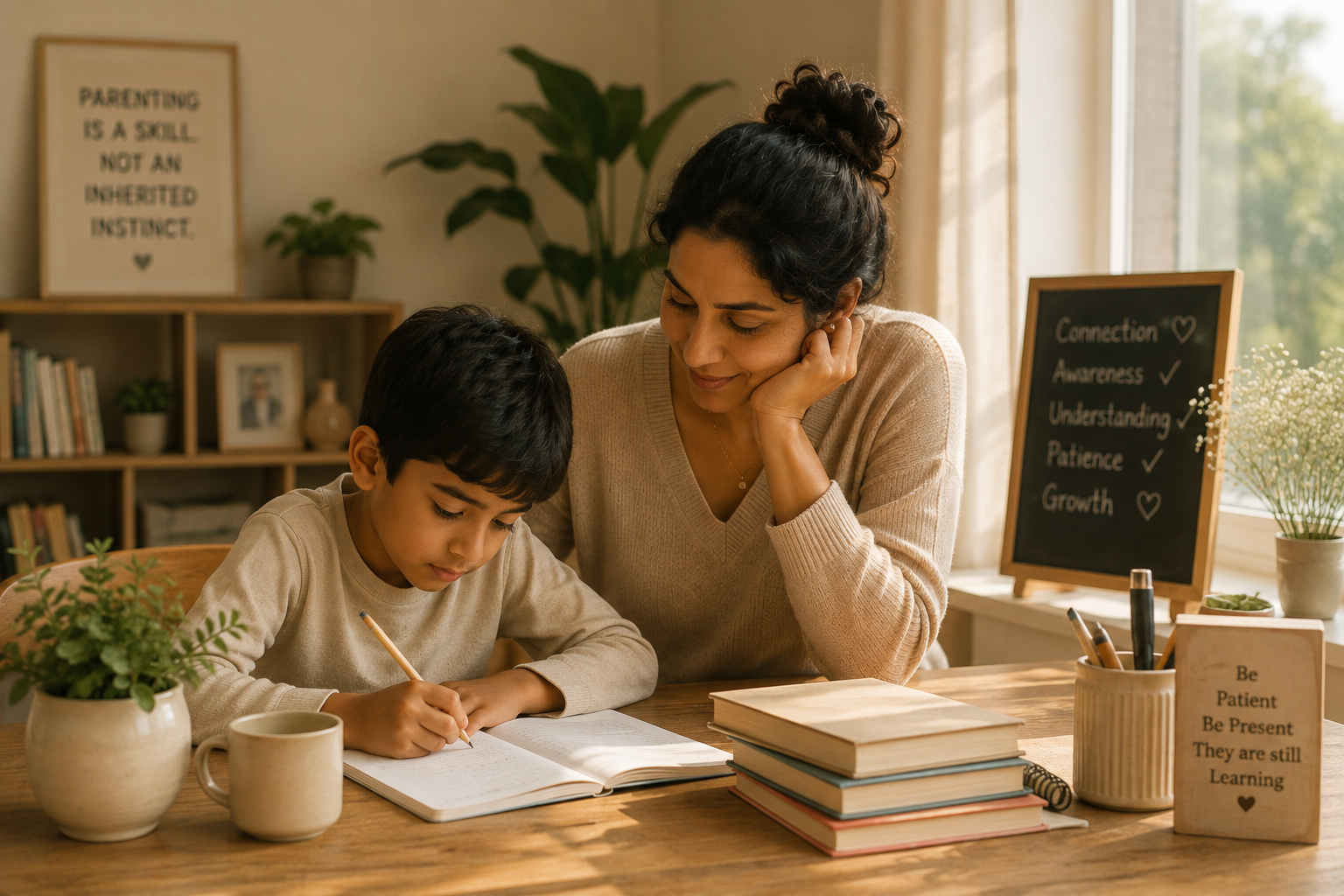
Toys on the floor. He was five minutes late coming home because he stopped to play. He did not study properly. He made the same mistake again. He did not follow the one instruction I had given him ten minutes ago.
None of these things are big. Any one of them, on its own, is nothing. But for a long stretch of my life, any one of them was enough to make me snap.
Frustration had quietly become my default state. Not the occasional bad day, the baseline. My son learned to read the air before he even walked in. He would either go silent or get a little scared of me, and I would watch it happen and feel something twist in my chest, and still not know how to stop it from happening again the next day.
There was no single day this started. No fight, no incident I can point to and say, that was the moment. It built slowly, through months of watching myself and not liking what I saw. I felt disconnected, from myself and from him. I could not understand his point of view. I could not enter his world. And somewhere in that fog, one realisation finally surfaced clearly enough to act on.
There was a gap between how I was parented and how I actually needed to parent him. And nobody had ever taught me how to close it.
Our parents did not need to learn this. We do.
For most of our parents, parenting was not something they studied. It was something they simply did, the way they had been raised, passed down almost without thought. Discipline meant control. Love was assumed, rarely spoken. Nobody sat with a child to understand his inner world, because the outer world was not asking that of children yet.
Today, that same instinct falls short, though not through any fault of our parents. The child in front of us is simply growing up in a world they never had to navigate.
Think about everything a parent is now expected to hold. Building genuine connection instead of assuming it. Staying updated with a teenager's world, his language, his pressures, his phone. Learning phonics ourselves, so we can teach a child in a way we were never taught. Managing extracurriculars that did not exist in our own childhoods. Being emotionally available on demand. Noticing, listening, and responding consciously instead of reacting on instinct.
Read that list again and it stops looking like a checklist of chores. It is a full skill set, and skill sets are learned, not inherited. Nobody is born knowing them, and nobody's own upbringing necessarily prepared them for it either.
Why this feels like failure instead of a learning curve
Here is where most mothers get stuck, and where I got stuck too. We measure ourselves against a standard we absorbed growing up, be calm, be patient, be endlessly available, while trying to meet demands our own parents never had to meet. Then we blame ourselves when we fall short, as if the falling short is proof that something is wrong with us.
It is not proof of that at all. It is proof that the job changed and the training never arrived.
The truth was simpler than a character flaw, and harder to admit. I had never learned to read my own child's world, or my own reactions inside it. Once I could see that clearly, I stopped treating my frustration as something shameful and started treating it as a signal, something to get curious about instead.
What actually closes the gap
Once I named it as a skill rather than a failing, I could finally start building it, the same way you would build any other skill: deliberately, and one layer at a time.
It started with observing myself before observing him. What was I feeling right before I snapped. What need of mine was going unmet in that moment. That awareness came first, before any technique, because no tool works in the hands of someone who has not yet seen what she is working with.
Then came understanding his world on its own terms, not the world I grew up in, not the world I assumed he was in, but the one he was actually experiencing. What scared him. What he needed to feel safe enough to come home and tell me the truth instead of hiding it.
The toys still end up on the floor sometimes. He still forgets instructions. But the difference now is what happens in the moment after. He is not silent anymore. He is not scared of me anymore. I did not become more patient overnight. I built a skill I once thought I simply lacked.
You are not behind. You are just early to something new.
If you feel like you are constantly catching up as a parent, understand what that feeling actually is. It is not evidence that you are failing. It is evidence that you are the first generation being asked to do this consciously, without a manual, without your own parents' example to fall back on.
You are not supposed to already know this. You are supposed to learn it. That is the whole point.
The moment you stop asking why can I not just do this naturally, and start asking what do I need to learn, everything about how you see yourself as a mother begins to change.
Ready to start learning the skill nobody taught you?
Every Wednesday and Sunday, I run a live webinar for mothers who are done blaming themselves for something that was never their fault to begin with. We go into exactly this, understanding your child's world, understanding your own reactions inside it, and building the awareness that makes every other tool actually work.
There is nothing to catch up on. There is only something to learn. Come learn what was always missing.


Join The TNN Mothers Circle
A free WhatsApp community where mothers receive daily guidance, reflections, emotional support, and reminders that they are not alone.
Attend The Calm Motherhood Path Webinar
Understand why you keep getting triggered as a mother and learn simple tools to respond with more calm, confidence, and connection.
Book A 1:1 Clarity Call
For mothers who want personalized support, deeper clarity, and a clear roadmap forward.